Tuesday, March 28, 2023

Wonders in the Sky

(Extract from my review that appear in the Australian "Ufologist" in 2010)

“Wonders in the Sky” is an important contribution to the debate as to whether a UFO phenomenon as we relate to today existed back in ancient times through to 1879. Jacques Vallee is well known in the UFO field and his 1969 book “Passport to Magonia – From Folklore to flying Saucers” is perhaps an inspiration for “Wonders in the Sky.” Both have major catalogues of cases, the former “A Century of UFO landings (1868 – 1968)” and the latter a catalogue on a much longer time scale. Chris Aubeck is the coordinator of the Magonia Exchange List which since 2003 has functioned as a network of researchers focusing on pre-1947 UFO events. 

Only two Australian cases make the listing: No. 408 1828 Mount Wingen and No. 474 1868 Parramatta. The Mount Wingen case is of questionable value as its 1828 date is uncertain. The account claims a cigar-shaped object landed and implies the incident may be the cause of the long known “Burning mountain” connection. This latter aspect is not noted in the Vallee/Aubeck compilation but should have been mentioned by way of context, as the account is of folkloric quality and its connection to when the coal seam started burning is uncertain. The 1868 Parramatta case – the very strange contact experience of Frederick Birmingham – is much better documented. I conducted a very detailed investigation of the story in the latter part of the 1970s and early 1980s. It is one of the most fascinating and detailed Australian historical cases I have come across. While I have a great interest in these historical cases, I think it is a matter for further research and debate as to whether there is credible evidence prior to the early 1800s of the UFO phenomenon as we know it today. Jacques Vallee and Chris Aubeck have made a valuable contribution to the debate. 

The Fourth Level and the Fourth Kind

(The post was first published in September 2006 on the OZ Files site)

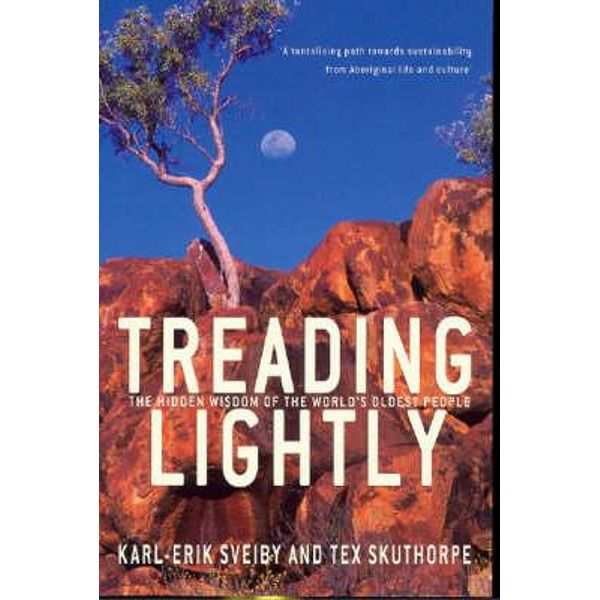
Treading Lightly, The Hidden Wisdom of the World's Oldest People by Karl  Erik Sveiby | 9781741148749 | Booktopia

One of the most interesting books I have read in 2006 is "TREADING LIGHTLY The hidden Wisdom of the world's oldest people" (2006) by Professor Karl-Erik Sveiby (a specialist in Knowledge Management) and Tex Skuthorpe (an aboriginal Nhunggabarra cultural custodian).


The book represents "a unique journey into traditional Aboriginal life and culture, and offers a powerful and original model for building sustainable organisations, communities and ecologies. It is a compelling message for today's world."This central message of the book is well worth your time to explore. Indeed it is of vital importance.


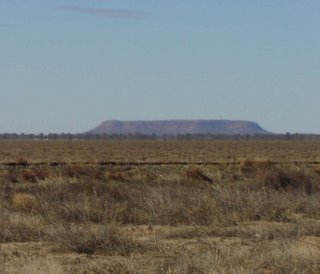
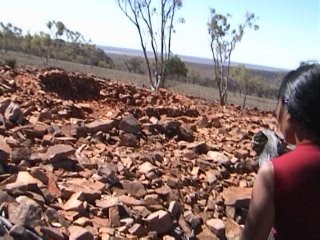
The different explorations of Karl-Erik Sveiby and I intersected rather unusually in 2004 when he approached me and researcher Steve Walters to get our opinions on a strange photographic anomaly - a possible aerial anomaly - he had recorded during April 2004 at Mount Oxley near Bourke New South Wales while in the company of Tex Skuthorpe and his partner. Karl-Erik presents the unusual photo in the book as a possible manifestation of the Fourth Level of meaning in aboriginal stories - the spiritual realm. Through the fascinating aboriginal story of How the Nhunggabarra got flowers Mount Oxley (or Wubi-Wubi) was a focus of shamanic contact between aboriginal men of high degree (or wiringins) and the ancestral being Baiame (Baayami) .


Mount Oxley had already become an interesting place for me. I visited it back in September 2003 exploring its fascinating sense of presence and its enigmatic lore of strange phenomena. I was already aware of the legend of the flowers through the renderings of K. Langloh Parker of local aboriginal tales she collected in the late 1890s and it was fascinating to see the story retold through the words of local custodian Tex Skuthorpe and its "Fourth Level" of meaning, and its beautiful evocation through Tex's great paintings.


While prosaic explanations may be evident for the photo anomaly Karl-Erik recorded it is fascinating to consider the context he and Tex explore in their important book. I certainly do not want to distract from the central message of "Treading Lightly" given its significance as a potent intersection between a remarkable old culture and modern knowledge management theory.


However I suspect there are fascinating resonances between the concepts of "Fourth Level" (through "Treading Lightly" - shamanic spiritual interactions) and "Fourth Kind" (through "alien abductions") - intersections I have been contemplating for some time. See for example my article "Alien Abductions: A Shamanic Perspective of UFOs" in Nature and Health magazine (August 1990) and my updated 2 part   version published in "New Dawn" in 2021:


1947 and beyond - the coming of the saucers down under

(This article was first published in July 2006 on the OZ files site)

"Flying saucers" entered the mainstream in 1947. Initially perceived as an American passing fad newspapers in Australia picked up on the controversy. It wasn't long before locals were reporting their own "saucer" sightings. There were many reports before 1947 but it was this wide public manifestation and reporting that ushered in the "flying saucer" era which in turn would be recognised and defined as the UFO phenomenon. 


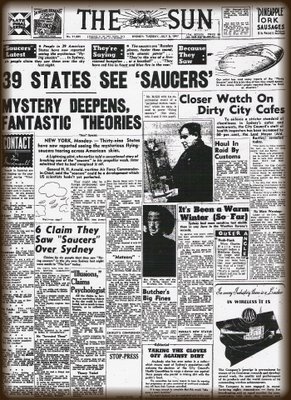
An example of the Australian reporting of the period can be seen in this front page of the Sydney afternoon newspaper "The Sun" of July 8 1947 - "39 STATES SEE 'SAUCERS', MYSTERY DEEPENS, FANTASTIC THEORIES, 6 Claim They Saw "Saucers" Over Sydney, "Illusions," Claims Psychologist." Other Sydney newspaper coverage at the time included the following headlines: "First 'Saucer' Found Was A Balloon" (a reference to the Roswell story - The Sun, July 9), "MORE 'FLYING SAUCERS' REPORTED IN U.S." (Daily Mirror July 7), "TWO "FLYING SAUCERS" SEEN TO LAND IN U.S., Searchers Fail To Find Any Traces, Phenomena Seen By Sydney People." (Daily Mirror, July 8), (and in a measure of how quickly the treatment changed) "SAUCERS BEGINNING TO MAKE FOR SHELVES, Back-To-EARTH Flight Route, Festival For the Screwballs." (Daily Mirror, July 9) Inside the Mirror reported "FLYING SAUCER" GROUNDED ON RANCH Handed Over to U.S. Army DETAILS OF DISC KEPT SECRET. SKY GAZERS GOT IT IN THE NECK (this story announced "Sydney people have given up gazing into the heavens after "flying saucers") , The Sydney Daily Telegraph newspaper reported a similar evolution in reporting: "FLYING SAUCERS" REPORTED IN AMERICAN SKIES (July 7), "AMERICAN PLANES PATROL FOR "FLYING SAUCERS" (July 8), "It Was Only A Storm In A Saucer U.S.A. NOW LAUGHS AT DISC "Flights Of Fancy" (July 9), "Flying Saucers" Queer Tales Told By "Observers" (July 9). Sydney's "newspaper of record" - the Sydney Morning Herald chimed in with stories like "Students At Sydney University See "Flying Saucers"; Professor F..S. Cotton's Theory" (July 8) and "Sydney People Still Say They're Seeing "Flying Saucers" (July 9).


It was a pretty tough gauntlet that any "saucer" spotter would have to run. The media treatment ensured that the UFO phenomenon's manifestations would remain largely marginalised and somewhat hidden. For Australia at least it would take a rash of sightings in 1950 to give a more substantial public launch for the UFO mystery down under. These included the sightings of Fred Bepps in Geelong Victoria during June 1950 and Alex Holland near Avoca Victoria in July 1950.


It is ironic that the reporting of a less compelling sighting in New South Wales in April 1950 on the front page of the "Sunday Sun" of April 23 (THEY CALL THESE FLYING SAUCERS Strange sight scares women) may have registered prominently in the consciousness of the "father of Australian ufology" Edgar Jarrold. Inside the same issue Jarrold was "profiled" in the Sun's "People: Human Stories" but not for any UFO or flying saucer angle. That would come with his own sighting in the following year (1951), which led to him to form his Sydney based UFO group - the Australian Flying Saucer Bureau - in July 1952. The Sun's 1950 "profile" described Jarrold as "a man with a secret" - "a book with such a weird plot that it frightens him whenever he thinks about it", a mystery novel called "Death's Darkness". Interviewed at the plaster factory where he worked Jarrold lamented the lot of a struggling writer. He indicated, "I received no encouragement from my parents, who simply bought me expensive accountancy courses which I never finished." The piece is accompaned with a photo of the 31 year old Edgar Ruce Jarrold. A better copy of the photo of Jarrold used in the article was kindly provided to me by his son Karl. The same column reported that E. Stanley Brookes of the Melbourne Society of Psychic and Occult Scientific Research had psychic circle "insights" into the nature of "flying saucers" - "radar-controlled war weapons ... being experimented with by at least two nations". Stanley Brookes, indicated he was also known as "the Graveyard Man" and "the only Australian Red Indian Chief". I think I get his "grave" drift .... lets put it down to the era and a bit of eccentricity.


Jarrold's past was rather colourful and interesting. Indeed during World War Two he languished for some time in an internment camp on the Isle of Man for expressing anti-British opinions and becoming a security concern. His internment was probably over extended because of the complication of his use of a false name - Roy Peter Simpson. He was eventually released returning to Australia in August 1943. An extensive security file exists and is accessible via the National Archives of Australia (File Series A367 Item C70388) Keith Basterfield of the Australian Disclosure project kindly provided me with a copy of the file in 2004.


Despite the delayed and tentative beginnings the UFO controversy in Australia is an extraordinary manifestation of a global phenomenon with many rich and potent expressions with numerous breakthrough cases and developments emerging from down under. 

(Front page of the Sydney newspaper "The Sun" from Tuesday, July 8th, 1947 was copied by Bill Chalker from the microfilm file of the Sun newspaper held at the NSW State Library, Sydney)

John Fowles, "A Maggot", Graham Hancock's "Supernatural" and alien contact

(This post was first published November 2005)

I agreed with Jacques Vallee when I read the following in his 1988 book "Dimensions":

Many descriptions of UFO phenomena force us to deal simultaneously with ... the physical (or technical) and the spiritual (or divine) ....

It has been captured in the most complete and most artistic form in John Fowles's extraordinary masterpiece, A Maggot, published in 1986.


My only correction is that "A Maggot" first appeared in 1985. A first edition has a special place in my library and my literary sensibilities.

In the paperback edition of "Dimensions" an interview with Vallee has him, in my view at least, stating the obvious:

... one of the greatest living writers in the English language publish(ed) a masterpiece dealing entirely with the problem of alien contact ...


What does "Ann the Word" and "A Maggot" have to do with each other? Rather than spoil the journey for those who want to discover both, and by way of haunting invitation, I'll simply pose the Chinese "koan" from Cao Xueqin's "The Dream of the Red Chamber" (per David Hawkes translation) I used by way of introducing my book "Hair of the Alien":

Entering "The Land of Illusion":

Truth becomes fiction when the fiction's true;

Real becomes not-real when the unreal's real.

And from "A Maggot" (page 359):

Q. Why stop you?

A. The maggot.

Q. What maggot?

A. That floated in the inner cavern, like a great swollen maggot, white as snow upon the air.

Q. What is this?

A. Yes, like a maggot, tho' not. Its great eye shone down upon us, my blood did curdle in my veins; and I must perforce call out in my fear, ignorant that I was.

John Fowles has now left us on his own spiritual odyssey, perhaps to his "maggot" - a gateway to some greater place of knowing. The Sydney Morning Herald, sourcing the Guardian, November 9, 2005, indicated "the novelist who brought sexiness and popular appeal to the serious literary novel, has died from heart failure (at 79) near his home in Lyme Regis, southwest England."

Take a look at Eileen Warburton's biography of Fowles if you are interested in some matters pertinent to the creation of "A Maggot".

Surprisingly researcher Graham Hancock takes a similar journey in his new book "Supernatural - Meetings with the Ancient Teachers of Mankind", published in the UK in October 2005. While examining the nexus of spirits (via shamanism), fairies (in part via "The Secret Commonwealth" and Vallee's "Passport to Magonia") and aliens (via alien abductions) Hancock presents some fascinating material and perspectives for those who have not yet looked into these interesting areas. While suggesting that these experiences may represent mankind receiving "contact" via altered states of consciousness with "real" entities beyond the physical, he does not really confront the physical dimensions of the mysteries he confronts.

While asking many of the same issues and questions (invoked by shamanism, fairy lore and alien abductions) in my own new book "HAIR of the ALIEN" (published in the US in July 2005) I squarely confront the issue of the physical dimensions of these issues, most potently expressed, I suggest, in the physical evidence I present with the alien DNA paradigm.


HAIR of the ALIEN - DNA paradigm, teleportation & "Elle-maids"?

(first published in July 2005 on "The OZ Files")

The extraordinary encounter Peter Khoury had with two strange female entities in his Sydney Australia home back in July 1992 provided my APEG team with a strange hair sample which ultimately yielded striking DNA results suggestive of advanced cloning & DNA techniques. This incredible case is a potent touchstone for the primary focus of my new book "HAIR of the ALIEN - DNA and other Forensic Evidence of Alien Abduction". The nature of the DNA evidence in this case supports the claims of Peter Khoury that he had a confronting encounter with a blonde female being, which seemed to involve bizarre behavioural elements. In an attempt to stop the claustrophobic and overpowering nature of the entity's actions - forcing him to her breast - Khoury bit her! He began to cough in apparent reaction. The strange pair are suddenly gone, in just as mysterious circumstances as their arrival in side what was thought to be a secure house. "There is important evidence of the women's presence to be recovered and a story to be told."


The hair sample and the intriguing DNA data that emerged from it anchor Peter Khoury's experience in reality. It is not the stuff of hoaxing, delusion, hallucination or other prosaic factors. 


How did these strange women arrive and leave so suddenly? - a phenomenon often reported in UFO abduction experiences. The initial strange perception of the women by Peter Khoury (like he was seeing himself through a transparent version of himself) was rapidly replaced by the certainty for Peter Khoury that these women were really present. The hair sample recovered and the DNA results attest to that reality. Without that evidence it would have been tempting to view the encounter in rather more non-concrete terms - a vision, an apparition or a hallucination? Given the evidence perhaps the visitors arrival was facilitated by some phenomena such as what we might speculate as being "teleportation".


During an open line segment on a ABC (Australian Broadcasting Commission) radio programme on March 24 1975 a caller identifying himself as Mr. Campbell described a "teleportation" (Star Trek style "beam up") experience he claimed he witnessed at his home not far from the US base in north western Australia at North West Cape. After observing a UFO passing low over the sea, Campbell claimed that later that evening at his home, while trying to recall details of the event, he felt "a telepathic presence in the room." Campbell said he felt this presence seemed to move closer as if engaged in watching him. He looked around and saw nothing, but somehow got the impression that the "presence" was about 5 feet 6 inches tall. Campbell claimed he tired of this situation and turned around and looked at the invisible "presence" at what would have been eye level and said, "Good day, mate." Campbell professed to not be prepared for what happened next, neither it seemed was the "presence". Campbell said he could see the shimmer of a form taking place. A feeling of coldness pervaded the room as a figure formed by striated horizontal bands of blue and yellow light began to appear. Even Campbell likened it to the TV show Star Trek "beam up" effect. Then just as quickly as it had appeared this manifestation started to reverse itself and then there was nothing, save a seemingly mental "telepathic concept" communicated to Campbell, to the effect of "clever" or "smart". Campbell surmised that when he turned around and said "hello", the "presence" must have thought it was visible, and began a process to rectify the apparent situation. Immediately realising it was becoming visible, Campbell thought, the "presence" reversed the process again, projecting the thought to Campbell that he was being "clever" or "smart". Two further "presences" appeared in his bedroom, one apparently amid the wooden bed structure. Campbell's wife began to wake up. He "suggested" to the "presences" they leave. With that, they apparently did and Campbell claimed there was an associated loud clicking noise as though some reforming process was occuring in the wooden bed structure in the wake of the "presences" departure. While the account is antecdotal it still captures some of the realities claimed by others who report encounters with "teleporting" UFO entities.


Dr. David Darling (author of "The Extraterrestrial Encyclopedia", "The Universal Book of Mathematics" and "Life Everywhere - the Maverick Science of Astrobiology") has just had a book published entitled "Teleportation - the Impossible Leap". He was quoted at www.space.com saying, "Any strange comings and goings are candidates for teleportation, although you would obviously have to eliminate all mundane explanations first... According to reports, some UFOs do appear and disappear quite abruptly, which would fit in with the basic idea of teleportation. " The same can be suggested for many accounts of alleged encounters with aliens here on Earth. Darling speculated, "We might expect advanced aliens to be occassionally beaming in to check on our progress as a species."


While aspects of the 1992 encounter (such as the recovered hair sample and its intriguing DNA, and the unknown nature of the arrival and departure of the strange women) resonate powerfully with the idea that we might be dealing with some bizarre form of interaction with an advanced alien presence intruding into our world, the events also resonate with other strange, but perhaps rather more nebulous aspects of our past.


Sydney researcher Steve Walters drew my attention to the following strange tale from Scandanavian folklore which is striking in its similarities with Peter Khoury's encounter with the "Nordic" blonde female entity. Thomas Keightley records the story of the "Elle-maid" in his classic 1880 study "The Fairy mythology" (republished as "The World Guide to Gnomes, Fairies, Elves and other Little People").


"A farmer's boy was keeping cows not far from Ebeltoft (a village in North Jutland, current Denmark). There came to him a very fair and pretty girl, and she asked him if he was hungry or thirsty. But when he perceived that she guarded with the greatest solicitude against his getting a sight of her back, he immediately suspected that she must be an Elle-maid, for the Elle-people (Elf people) are hollow behind. He accordingly would give no heed to her, and endeavoured to get away from her; but when she perceived this, she offered him her breast that he should suck her. And so great was the enchantment that accompanied this action, that he was unable to resist it. But when he had done as she desired him, he had no longer any command of himself, so that she had now no difficulty in enticing him with her. He was three days away .... (Upon his return) He slept for many days as the enchantment had lasted ..."


While the Khoury sample DNA evidence invited some strange speculations that nudged the often discussed similiarities between alien abduction experiences and the fairy lore tradition, it is fair to say that there are more differences between fairy lore accounts and alien abduction accounts than there are similarities. Therein lies the quandary - a connection or a damaging distraction?

THE GERM GROWERS - 1892 - ALIEN INVADERS BEFORE WELLS' "THE WAR OF THE WORLDS"

(This post was originally published on "The OZ Files" in June 2005)

BEFORE "THE WAR OF THE WORLDS" THERE WAS "THE GERM GROWERS" - 1892


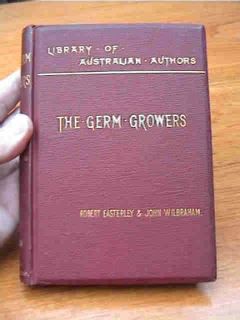
A few years ago I sat down in the NSW State Library in Sydney Australia and read an obscure novel - "The Germ Growers - An Australian Story of Adventure and Mystery" - published way back in 1892. While it's authorship was attributed in one edition to Robert Easterley & John Wilbraham, they were in fact the central fictional characters - two young English chaps who eventually come into contact with an alien "heart of darkness" in the Kimberley area of Western Australia - coincidentally home of the Wanjina (or Wanjina - see my earlier post). The real author was an Australian priest - Robert Potter - a canon of St. Paul's Anglican Church in North Melbourne, Victoria, Australia.


Reading the novel one can perhaps readily understand why it didn't capture the public imagination in England or Australia and languishing instead as a hidden oddity - perhaps the world's first science fiction novel focusing on an alien invasion - fully 5 years before H.G. Well's classic of the genre - "The War of the Worlds" (1897) - entered our imagination and took a permanent hold, particularly with Orson Welles famous 1938 Martian Invasion radio broadcast, George Pals' 1953 filmic Americanisation, Jeff Wayne's 1978 musical (with Richard Burton), and now in June 2005 with a majoring rebirthing via Steven Spielberg's blockbuster treatment.


Potter (1831-1908) gave us a florid tale of aliens from the ethereal dimensions of outer space who have set up "beach heads" in remote locales, intent on laying waste to humankind via germ warfare. Our young English adventurers discover the Kimberley outpost, bearing witness to the activities of the alien's flying craft - "invisible aerial cars" - and the sinister alien leader Signor Niccolo Davelli. Salvation from this cosmic invasion comes in the form of alien invervention - Leafar, ye of the good alien types. Leafar, read Rafael the "angel", and Davelli (the Devil) and you get the drift of Canon Potter's religious SF tract. Yes Potter plays out a cosmic war between good and evil - a theme revisited in the occult baggage served up in much of the contactee credo of the 1950s - but his tale replete with "alien abduction", "UFOs", and contact, was probably offered up as a clever reselling of godly redemption (if of course one chooses the right side in the cosmic war) something he may have thought might have had more popular appeal than his Tractarian publications - "A Voice from the Church in Australia" (1864), "An examination of Secularism" (1883), and "Replies to the Roman Catholic Archbishop of Melbourne" (1895).


Religious agendas intermixed with alien themes is certainly a popular theme - check out "The Gods have landed - New Religions from Other Worlds" edited by James Lewis (1995) and "UFO Religions" edited by Christopher Partridge (2003). Susan Palmer offers an interesting study with "Aliens Adored - Rael's UFO Religion" (Rutgers University Press, 2004). Further anchor points and alternative perspectives may be found in such studies as "The Lure of the Edge - Scientific Passions, Religious Beliefs, and the Pursuit of UFOs" by Brenda Denzler (University of California Press, 2001), and "Heavenly Lights - the Apparitions of Fatima and the UFO Phenomenon" by Portuguese historians Joaquim Fernandes and Fina D'Armada (2005) (a theme visited by Jacques Vallee in his book "The Invisible College" (1975) and in potent fictional form in John Fowles' striking novel "A Maggot" (1985).

WANJINAS, VISITORS & UFOs

(This post was originally posted on "The OZ Files" site in May 2005)

This book is well worth examining, particularly by those tempted to speculate that the Wanjina (or Wandjinas - their most widespread spelling variant) are evidence of "extraterrestrials" visiting Earth. I have been a cautious traveller in this context. On my web site (www.theozfiles.com) and in my earlier book "The OZ Files - the Australian UFO Story" I speculate as follows:


The legends and lore of the indigenous aborigines also provide material suggestive of interactions with anomolous aerial phenomena. Of course, in speculation about such data, it should be realised that the accounts are of historical and anthroplological nature and therefore care should be taken not to interpolate too much into them.

Aboriginal myths incorporate the idea of "sky-beings", with the Wandjina being among the most interesting to consider. The Wandjin have been preserved in a fascinating oral tradition and in a large collection of rock paintings scatteredthroughout the Kimberley region of northern Australia. The paintings have received all manner of interpretations from stylised representations of a pervasive myth system to naive "ancient astronaut" theories. It is however fascinating to see that the indigenous tribes viewed the Wanjina as "the spirit in the cloud". Indeed, the unique painting style shows a logical sequence from human figures to stylised representations of clouds. This duality of anthropomorphic form and "clouds" is widespread in primitive cultures and finds an interesting parallel in the biblical accounts in "Exodus". While this line of thought is suggestive of superior "sky beings" acting as cultural catalysts for primitive societies, I should point out that making mythological component comparisons, can make for interesting exercises, full of emotive similarities, but are purely speculative.

Such speculations need to have their anchor points in the living and preserved traditions of the people who view the Wanjinas as their primary "religious" focus. To not do so is to ignore a primary and fascinating source of oral and pictorial knowledge about these extraordinary beings - the Wanjinas.

Their resonances with some alien descriptions and contemporary alien abduction lore is fascinating. In my new book "HAIR of the ALIEN" I refer to a witness' description of entities, which was described by prominent "alien abduction" claimant Whitley Strieber as "the best description of the gray beings". For the witness - an Australian woman - "the most strikingly similar image to that of the beings is the Wandjina - the haunting Australian aboriginal rock paintings that reveal figures with large dark eyes and no mouth."


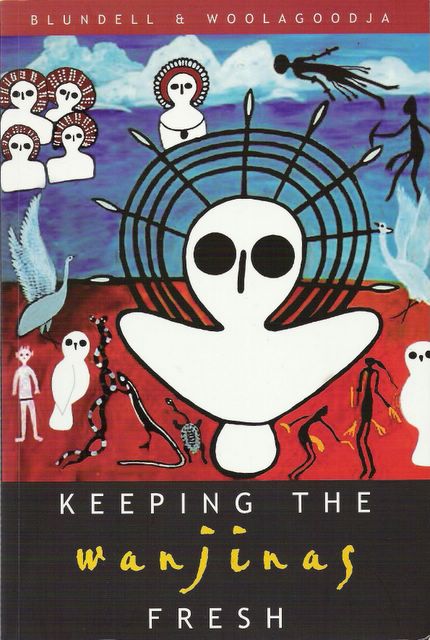
An excellent new book on the Wandjina (or Wanjinas) "Keeping the Wanjinas fresh" by Kimberely Wanjina artist & carer Donny Woolagoodja and anthropologist Valda Blundell strikingly documents the Wanjina rock paintings and the living tradition that is being keep "fresh" through "touching" up the old rock paintings and creating new "modern" expressions of the Wanjina - "eternal manifestations of the sacred life force ... the supernatural ancestors" of the local aborigines (including the Worrorra, Ngarinyin and the Wunambal). Donny Woolagoodja has a direct linkage to the "retouching" tradition through his father Sam Woolagoodja.

The book highlights "the Wanjinas created the countries that their human descendants belong to and they made the laws that guide their everyday lives. Visible as paintings at hundreds of rock art sites throughout their countries, the Wanjinas remained sources of strength for Sam and his people during the tumultuos years of colonisation. Even after the Worrora were displaced from their countries, the Wanjinas continued to instruct them in their dreams." Further the book highlights "Expressions of the Wanjinas can be seen in the night sky, for instance the Milky Way. They are also closely associated with clouds and water ... Sam once told (Blundell) that the Wanjinas 'came through clouds'. "That's their home,' he said; 'they come from rain.' People are 'born in sunlight', while Wanjinas are 'born in the dark'. 

People around the world would have seen the Wanjina rising from the ground in the opening ceremony of the 2000 Sydney Olympics. Donny Woolagoodja was the traditional artist behind that extraordinary display. Most pivotal in the book, beyond the beautiful contemporary Wanjina artwork, is the "refreshing" tradition among chosen local people. 

I noted that Donny's "refreshing" of the the rock painting Wanjina Namarali at Karndirrim in 2002 made some "changes" to the old original representation, most noteably giving it a much thinner neck, a head leaning to one side and longer arms. I wondered about the importance of this but the book elaborates "while most of the Wanjinas have lost their mouths, they are still able to instruct people in their dreams. According to Donny, those aspects of recent paintings that appear to be 'new' are actually contemporary revelations of Lalai ("the primeval era of creation" or "the Dreaming" - an eternal sense of "living cosmology") . Donny explains, 'When I paint, I follow the dream.' "

This book is well worth examining, particularly by those tempted to speculate that the Wanjina (or Wandjinas - their most widespread spelling variant) are evidence of "extraterrestrials" visiting Earth. I have been a cautious traveller in this context. On my web site (www.theozfiles.com) and in my earlier book "The OZ Files - the Australian UFO Story" I speculate as follows:


The legends and lore of the indigenous aborigines also provide material suggestive of interactions with anomolous aerial phenomena. Of course, in speculation about such data, it should be realised that the accounts are of historical and anthroplological nature and therefore care should be taken not to interpolate too much into them.

Aboriginal myths incorporate the idea of "sky-beings", with the Wandjina being among the most interesting to consider. The Wandjin have been preserved in a fascinating oral tradition and in a large collection of rock paintings scatteredthroughout the Kimberley region of northern Australia. The paintings have received all manner of interpretations from stylised representations of a pervasive myth system to naive "ancient astronaut" theories. It is however fascinating to see that the indigenous tribes viewed the Wanjina as "the spirit in the cloud". Indeed, the unique painting style shows a logical sequence from human figures to stylised representations of clouds. This duality of anthropomorphic form and "clouds" is widespread in primitive cultures and finds an interesting parallel in the biblical accounts in "Exodus". While this line of thought is suggestive of superior "sky beings" acting as cultural catalysts for primitive societies, I should point out that making mythological component comparisons, can make for interesting exercises, full of emotive similarities, but are purely speculative.

Such speculations need to have their anchor points in the living and preserved traditions of the people who view the Wanjinas as their primary "religious" focus. To not do so is to ignore a primary and fascinating source of oral and pictorial knowledge about these extraordinary beings - the Wanjinas.

Their resonances with some alien descriptions and contemporary alien abduction lore is fascinating. In my new book "HAIR of the ALIEN" I refer to a witness' description of entities, which was described by prominent "alien abduction" claimant Whitley Strieber as "the best description of the gray beings". For the witness - an Australian woman - "the most strikingly similar image to that of the beings is the Wandjina - the haunting Australian aboriginal rock paintings that reveal figures with large dark eyes and no mouth." post was originally published on "The OZ Files" site in May 2005)
An excellent new book on the Wandjina (or Wanjinas) "Keeping the Wanjinas fresh" by Kimberely Wanjina artist & carer Donny Woolagoodja and anthropologist Valda Blundell strikingly documents the Wanjina rock paintings and the living tradition that is being keep "fresh" through "touching" up the old rock paintings and creating new "modern" expressions of the Wanjina - "eternal manifestations of the sacred life force ... the supernatural ancestors" of the local aborigines (including the Worrorra, Ngarinyin and the Wunambal). Donny Woolagoodja has a direct linkage to the "retouching" tradition through his father Sam Woolagoodja.

The book highlights "the Wanjinas created the countries that their human descendants belong to and they made the laws that guide their everyday lives. Visible as paintings at hundreds of rock art sites throughout their countries, the Wanjinas remained sources of strength for Sam and his people during the tumultuos years of colonisation. Even after the Worrora were displaced from their countries, the Wanjinas continued to instruct them in their dreams." Further the book highlights "Expressions of the Wanjinas can be seen in the night sky, for instance the Milky Way. They are also closely associated with clouds and water ... Sam once told (Blundell) that the Wanjinas 'came through clouds'. "That's their home,' he said; 'they come from rain.' People are 'born in sunlight', while Wanjinas are 'born in the dark'. 

People around the world would have seen the Wanjina rising from the ground in the opening ceremony of the 2000 Sydney Olympics. Donny Woolagoodja was the traditional artist behind that extraordinary display. Most pivotal in the book, beyond the beautiful contemporary Wanjina artwork, is the "refreshing" tradition among chosen local people. 

I noted that Donny's "refreshing" of the the rock painting Wanjina Namarali at Karndirrim in 2002 made some "changes" to the old original representation, most noteably giving it a much thinner neck, a head leaning to one side and longer arms. I wondered about the importance of this but the book elaborates "while most of the Wanjinas have lost their mouths, they are still able to instruct people in their dreams. According to Donny, those aspects of recent paintings that appear to be 'new' are actually contemporary revelations of Lalai ("the primeval era of creation" or "the Dreaming" - an eternal sense of "living cosmology") . Donny explains, 'When I paint, I follow the dream.' "

This book is well worth examining, particularly by those tempted to speculate that the Wanjina (or Wandjinas - their most widespread spelling variant) are evidence of "extraterrestrials" visiting Earth. I have been a cautious traveller in this context. On my web site (www.theozfiles.com) and in my earlier book "The OZ Files - the Australian UFO Story" I speculate as follows:


The legends and lore of the indigenous aborigines also provide material suggestive of interactions with anomolous aerial phenomena. Of course, in speculation about such data, it should be realised that the accounts are of historical and anthroplological nature and therefore care should be taken not to interpolate too much into them.

Aboriginal myths incorporate the idea of "sky-beings", with the Wandjina being among the most interesting to consider. The Wandjin have been preserved in a fascinating oral tradition and in a large collection of rock paintings scatteredthroughout the Kimberley region of northern Australia. The paintings have received all manner of interpretations from stylised representations of a pervasive myth system to naive "ancient astronaut" theories. It is however fascinating to see that the indigenous tribes viewed the Wanjina as "the spirit in the cloud". Indeed, the unique painting style shows a logical sequence from human figures to stylised representations of clouds. This duality of anthropomorphic form and "clouds" is widespread in primitive cultures and finds an interesting parallel in the biblical accounts in "Exodus". While this line of thought is suggestive of superior "sky beings" acting as cultural catalysts for primitive societies, I should point out that making mythological component comparisons, can make for interesting exercises, full of emotive similarities, but are purely speculative.

Such speculations need to have their anchor points in the living and preserved traditions of the people who view the Wanjinas as their primary "religious" focus. To not do so is to ignore a primary and fascinating source of oral and pictorial knowledge about these extraordinary beings - the Wanjinas.

Their resonances with some alien descriptions and contemporary alien abduction lore is fascinating. In my new book "HAIR of the ALIEN" I refer to a witness' description of entities, which was described by prominent "alien abduction" claimant Whitley Strieber as "the best description of the gray beings". For the witness - an Australian woman - "the most strikingly similar image to that of the beings is the Wandjina - the haunting Australian aboriginal rock paintings that reveal figures with large dark eyes and no mouth."